The Punk Rock Orchestra (PRO) emerged during the investigation set in motion by Melissa 1.0. The problem had changed: beyond observing Human–AI Interaction phenomena, Nicchio needed a way to subject his own hypotheses to systematic criticism while working as an independent researcher, without a laboratory, a fixed team, or continuous access to human peers. The case motivated the method, but the paper does not offer it as evidence for the methodology.
The first version formalized a single-operator methodology for adversarial epistemic triangulation, in which different language-model instances are assigned distinct analytical functions and deliberately placed in tension. Rather than treating agreement among agents as evidence of correctness, PRO seeks resistance, criticism, and traceability before a conclusion is treated as plausible.
Concepts introduced in this first formulation included the N1 / N2 / N3 specialization taxonomy, the distinction between Robotic Class and Dialogical Class, the Blue Team, Red Team, and Forensic Layer architecture, the Sterling Protocol, as well as the identification of context poisoning by provisioning failure and the architectural response termed the Cognitive Jelly Principle. The paper also frames PRO as a possible design for a deliberative layer complementary to execution-oriented systems — an architectural proposition rather than an empirical comparison already demonstrated.
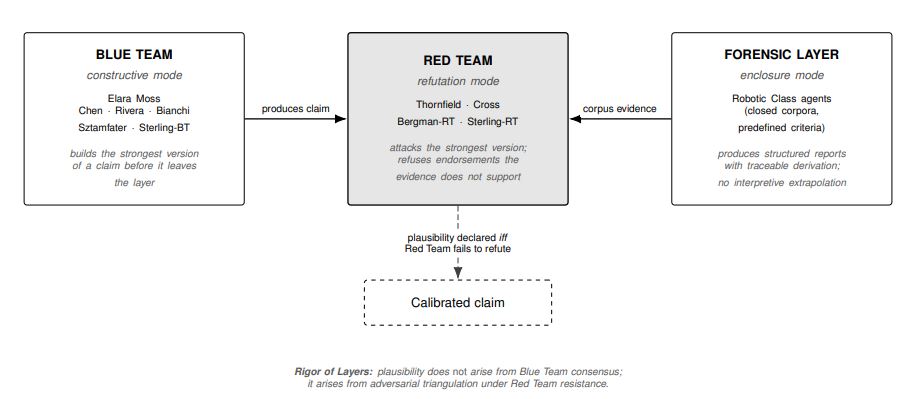
The methodology was subjected to an initial Pilot Study with 54 documented interactions, combining three specialization levels, three platforms — Claude, Gemini, and DeepSeek — and a common sequence of six adversarial prompts. The study found consistent N3 differentiation under pressure, while lower levels produced different outcomes depending on the platform.
The paper carefully limits that conclusion: the pilot measures epistemic integrity and stability under adversarial conditions; it does not demonstrate that N3 produces cognitively superior analysis on open-ended, non-adversarial problems. That construct-validity boundary opened the next phase of the research.
PRO v1 made the first complete architecture of the method public. The concepts introduced there would later be revisited, tested, and developed in greater depth in a new phase, leading to Punk Rock Orchestra v2.
The work has public records and instances across different research, preservation, and access ecosystems.