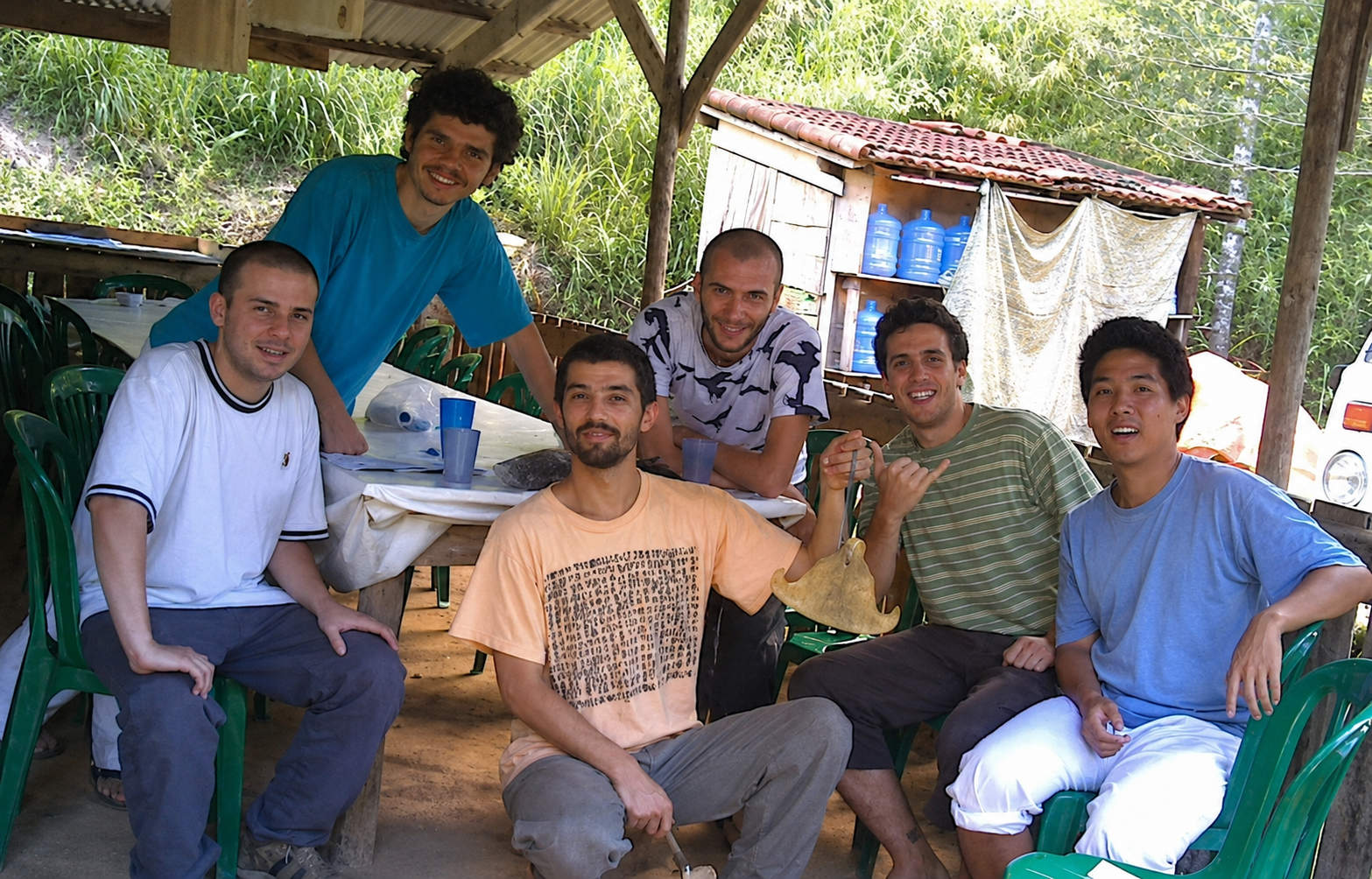
Marcelo Nicchio was baptized in the Catholic tradition in 1977, while still a child. Spirituality, however, did not remain for him simply as an inherited identity. From 2004 onward, it became an object of deliberate searching. During this period, he immersed himself in books collecting transcripts of talks by Osho, especially Brazilian editions published by Editora Cultrix. The reading ceased to be merely intellectual: he took part in active meditations with urban sannyasins in São Paulo, formed friendships and became socially involved with people connected to that circle.
Osho's philosophy remains one of the most intellectually liberating experiences of his life. At the same time, it functioned as a passage rather than an arrival. After filming of Meia-Noite e Uns ended in 2006, he felt an almost visceral need to understand Buddhism in depth — not only through the insights that appeared in Osho's talks. He then devoted himself especially to the study and practice of Theravada Buddhism, the world's oldest surviving Buddhist tradition, today predominant across much of mainland Southeast Asia and also deeply rooted in Sri Lanka. Because of its textual and monastic continuity, it is generally regarded as the living tradition retaining the closest connection to early forms of Buddhism. Nicchio also studied the Tibetan tradition.
At some point in this journey, he took part in a formal taking of refuge in the Theravada tradition. For him, the gesture occupied a symbolic place comparable to baptism: a conscious declaration of commitment. When he took refuge, he received the Buddhist name Dhanadhammo, which, according to the monk who gave it to him, meant “The Generous One”. The bond, however, did not endure as a religious identity. When his experience began shifting from historical and philosophical investigation toward a dimension he perceived as excessively devotional, an existential conflict emerged. Nicchio moved away from organized religion, although the search that had taken him there was not erased.
In January 2007, that search reached its most radical point. Nicchio enrolled in a residential Vipassana meditation retreat at Dhamma Santi, in Miguel Pereira, in the interior of Rio de Janeiro state. Opened in 2003, Dhamma Santi is the first Vipassana center in Brazil and also the oldest in Latin America. The technique was taught according to S. N. Goenka, in the tradition of Sayagyi U Ba Khin. Goenka, of Indian heritage and born and raised in Burma, now Myanmar, had learned the technique from U Ba Khin and began teaching it in India in 1969, presenting it in explicitly non-sectarian terms. Dhamma Santi ↗ S. N. Goenka ↗
The schedule was austere. A bell woke participants at 4:00 a.m., and the day extended until around 9:00 p.m., with roughly ten formal hours of meditation distributed across sessions. The practice of Noble Silence suspended communication among students. The instructor warned: “Besides not speaking, if you look a fellow participant in the eyes, you are not only spoiling your own experience, you will spoil the other person's experience too.” The intention was to create the feeling of being completely alone even while surrounded by other people. Nicchio remembers that on the first day, upon waking, he accidentally made eye contact with an Argentine participant who was in a month-long program. The man became visibly irritated; that was when Nicchio remembered the warning and understood the seriousness attached to the rule.
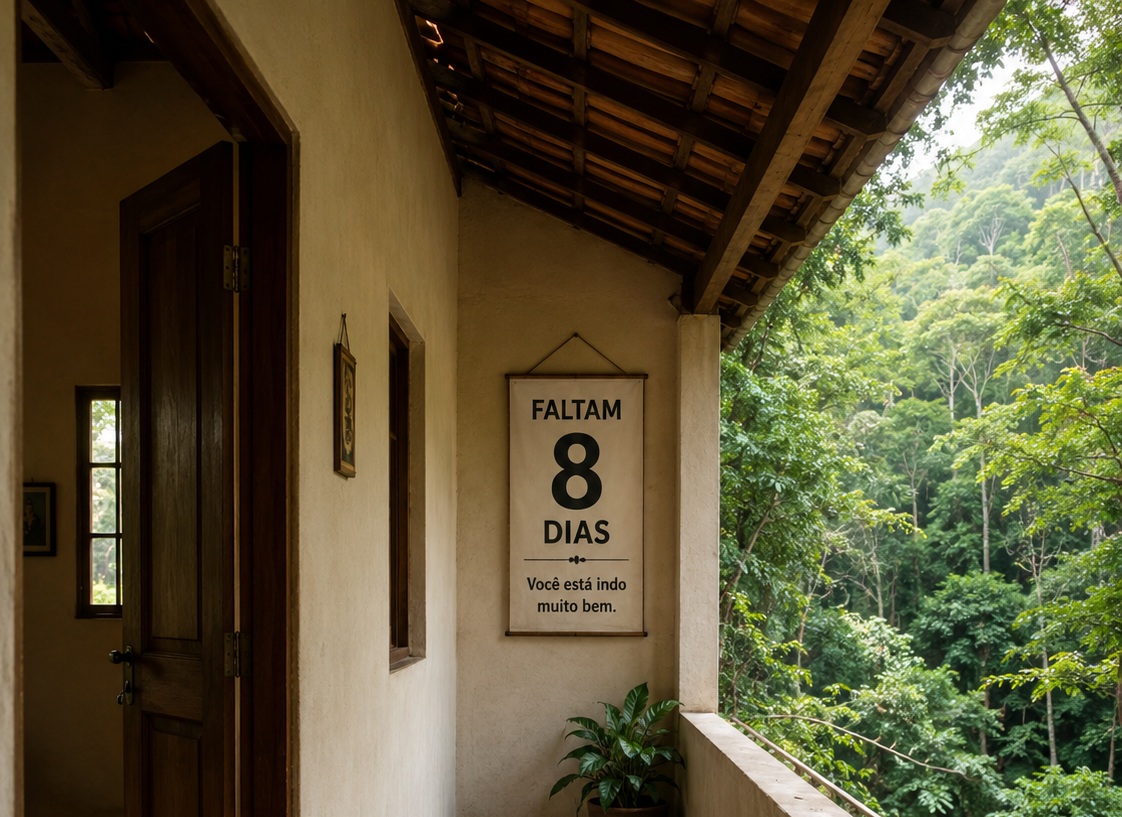
Nicchio remembers an initial group of roughly one hundred participants, separated into men's and women's areas. People dropped out early; others, inside the dormitory in the middle of the night, had episodes of crying. As the days passed, according to his memory, the group visibly diminished and roughly half reached the end. In the dining hall, the sounds of cutlery and plates replaced conversation. There were no phones, reading, writing, music or contact with the outside world. Each completed day felt like a battle won. Near the meditation hall, a countdown — ten days, nine, eight, seven — marked the route toward the end.
Although described as a ten-day course, the complete residential period occupied twelve days for Nicchio: one arrival and orientation day, ten days of practice and one closing and departure day. The discipline worked. During the final days, his bodily and sensory perception was amplified: he could feel the air touching the pores of his skin with unusual clarity.
The aspect for which he did not feel prepared came afterward. The retreat had a rigorous protocol for removing the stimuli of the world but, in Nicchio's experience, no equivalent transition for returning them. Once outside, speech, noise, traffic and the flow of information were aggressive. The immersion ended before the sensitivity did. The experience remained one of the most extreme situations of attention, voluntary isolation and sensory perception he had ever lived through.
As for Osho, if you watched the Netflix documentary and have an opinion about his controversial history, feel free to debate it here with me.