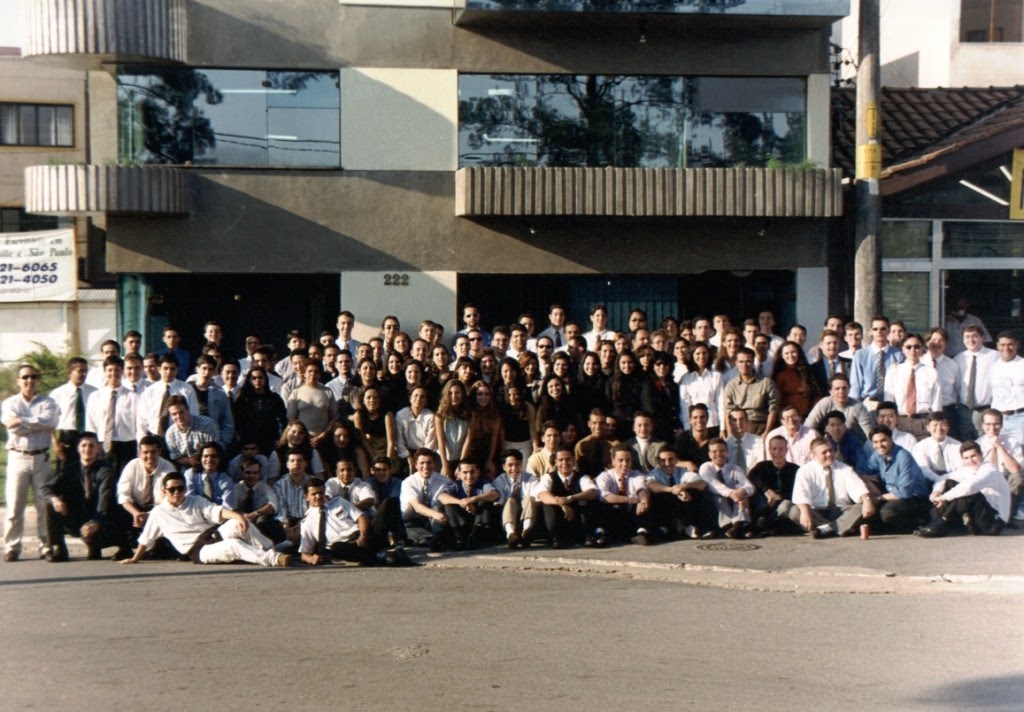
Marcelo Nicchio's time at PSINet, from June 2000 to May 2001, coincided with one of the most turbulent periods in the history of the commercial internet. But his relationship with the company's Brazilian operation had begun years earlier, back in the BBS era.
What began as the experience of an early user of digital communication services in Brazil would end inside a multinational whose aggressive expansion made it one of the emblematic casualties of the dot-com bubble.

From SP Online to STI Internet (1993–1999)
By around 1993, Marcelo Nicchio was already a user of SP Online, which would later become STI BBS and then STI Internet. He followed these changes as a loyal customer, when digital communication was still the preserve of a relatively small community of enthusiasts, long before commercial internet access became widespread in Brazil.
In 1994 or 1995, he visited STI's offices on Avenida Nove de Julho in São Paulo. He wanted to see the workings of a service he already used and to seek potential sponsorship for his radio program.
At the time, Nicchio's relationship with STI was entirely personal. There was no indication that he would eventually work for the same operation.
In 1999, a coincidence brought these worlds closer together. Alexandre Godoi, the keyboardist in his band, began working at STI Internet, which was by then based in Alphaville, in the São Paulo metropolitan area.
That same year, STI became part of one of the most ambitious expansion programs in the global internet industry.
PSINet arrives in Brazil
The American company PSINet, a pioneer in commercial internet connectivity and infrastructure, was undergoing rapid growth. Its international strategy combined network investment, data transmission capacity and acquisitions of regional internet service providers.
Brazil became one of the markets selected for that expansion.
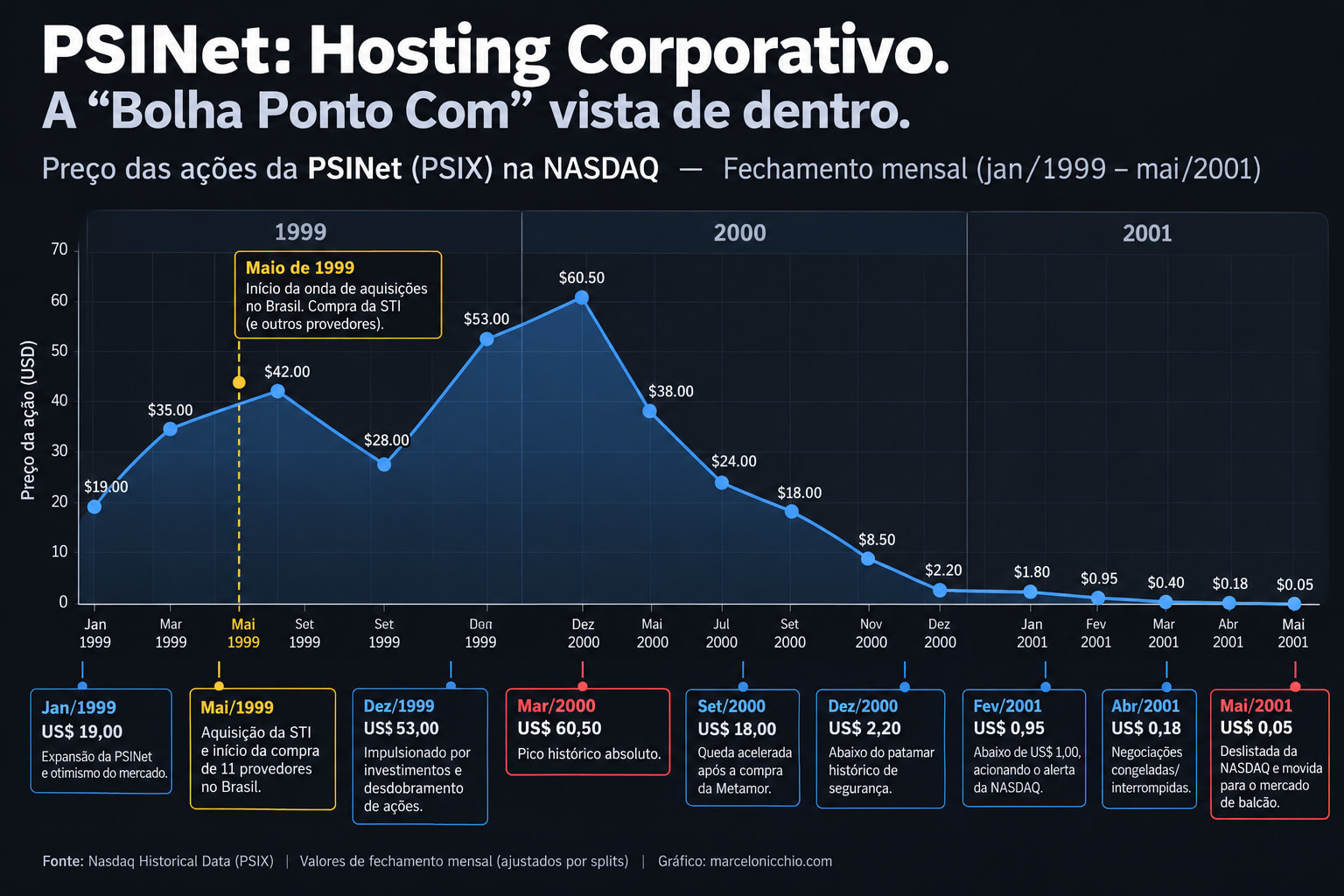
In April 1999, the company acquired Openlink, in Rio de Janeiro, and Horizontes Internet, in Minas Gerais. On May 24, 1999, it announced the acquisition of STI Internet, then considered Brazil's fourth-largest internet service provider.
Buying STI expanded PSINet's presence in São Paulo and helped establish it among the country's largest providers.
In the following months, more regional companies were incorporated into the Brazilian operation, including providers in Rio de Janeiro, Brasília, Bahia and the São Paulo interior.
The strategy was straightforward: rapidly acquire infrastructure, customer bases, geographic reach and market share, creating a national network connected to the company's international services.
In November 1999, PSINet announced plans to invest US$500 million in Brazilian infrastructure, excluding amounts set aside for further acquisitions.
The plans included data-hosting centers, business connectivity, corporate networks and e-commerce solutions.
The former STI, which Nicchio had known as a BBS user, was now part of a multinational with global ambitions and large-scale investments.
From customer to employee (2000–2001)
During STI's integration into PSINet, Alexandre Godoi introduced Nicchio to Rogério Carulli, a manager in the commercial department. That meeting led to a job offer.
According to his Brazilian employment record, Nicchio began working there on June 1, 2000, and remained until May 2, 2001, when he resigned.
His work focused on the sale of corporate internet and hosting services. The team served businesses exclusively, selling dedicated servers, shared-server hosting, corporate internet access and private data lines (LPs), among other connectivity and infrastructure services.
Residential internet access had been transferred to Inter.net, a company created to serve that market and located in the same business complex. Nicchio's commercial team focused on corporate customers.
He started at the Alphaville premises, which were still associated with the former STI operation.
Living in Santana, in the northern part of São Paulo, Nicchio drove along the Castelo Branco highway to work each day. His early shifts included evenings, from 6 p.m. to midnight.
When the headquarters moved to Tamboré, the commute remained essentially the same, but the shifts changed. He initially worked from 7 a.m. to 1:45 p.m. He later moved to 1:45 p.m. to 8 p.m., the schedule he preferred and kept for the longest period.
The workplace still carried the expectations of a company that had invested heavily in expansion. Yet events in the financial markets were quickly changing that outlook.
The dot-com bubble from the inside
In March 2000, a few months before Nicchio joined PSINet, the company's shares had reached approximately US$60 on the Nasdaq, reflecting the peak valuations of internet businesses.
PSINet had grown rapidly through international acquisitions, infrastructure investments and extraordinary expectations for the digital economy.
But the market was beginning to turn.
The bursting of the dot-com bubble ended the boom in technology stocks. PSINet, having committed enormous sums to its expansion, faced growing financial difficulties.
Its shares declined sharply through the second half of 2000. The fall continued in early 2001 until they were trading for mere cents.
Within the Brazilian operation, checking PSINet's Nasdaq quote became part of employees' daily routine.
The decline was no longer just a distant business story reported in newspapers or discussed by analysts. Its consequences were beginning to appear in employees' everyday lives.
When the phones began to fall silent
When Nicchio first joined PSINet, the commercial department handled a substantial volume of incoming calls.
The company invested in advertising, including billboards and print media, which helped attract demand for its corporate hosting and connectivity services.
The phones rang constantly. The work involved responding to businesses interested in products and services offered by the Brazilian operation.
As the months passed, however, that activity began to decline.
There was no sudden shutdown. The volume of calls gradually fell as commercial and financial conditions deteriorated.
During Nicchio's last months at the company, receiving a call had become a rarity.
The contrast was striking: a corporate infrastructure built for the growth of a major international company was now operating with very little demand.
The silence of the phones became one of the most tangible signs of the crisis inside the office.
As Nasdaq shares lost value, another side of the same story was unfolding in the commercial department: fewer calls, idle hours and a lack of new inquiries.
The dot-com bubble, so often represented by financial charts and billions in losses, could also be experienced in the workplace through the simple absence of ringing phones.
The fall of a giant
On April 3, 2001, Nasdaq suspended trading in PSINet shares, whose last quote had been close to US$0.19.
On April 27, the company was formally delisted from Nasdaq.
Nicchio was still part of PSINet's Brazilian commercial team when these events unfolded.
On May 2, 2001, five days after the delisting, he resigned.
The crisis continued to deepen.
On June 1, 2001, the American parent company and several U.S. subsidiaries filed for Chapter 11 bankruptcy protection, a legal process allowing indebted companies to reorganize.
In Brazil, the operation continued seeking a way forward. Unable to complete a sale, PSINet announced the end of its Brazilian activities on August 20, 2001.
It was the end of an expansion that, just over two years earlier, had seen the company buy some of Brazil's leading internet providers.
The end of a chapter
Marcelo Nicchio spent eleven months working at PSINet. His relationship with that operation, however, had begun nearly eight years earlier as an SP Online user.
Between 1993 and 2001, he witnessed the development of a pioneering BBS service into a commercial internet provider, its acquisition by PSINet and the financial collapse of a multinational seeking a substantial share of the global internet market.
His experience brought together different perspectives on the same period: that of an early participant in Brazil's digital communications scene and that of a professional selling infrastructure and corporate services during the bursting of the dot-com bubble.
The experience marked an important transition in his career, as the internet ceased to be only a field of personal exploration and became part of his professional life as well.
PSINet's story can be told through acquisitions, billion-dollar investments, debt and Nasdaq charts. For Nicchio, it was also associated with something more ordinary: the transformation of a busy commercial department into an office where the phones had almost stopped ringing.